Summer Ventilation Systems
Hot summers and warm climates are a challenge for warehouses and industrial spaces. These large buildings (which can measure anywhere from 100,000 SF to over 500,000 SF) are used as logistics centers for the distribution of goods, or as production facilities for the manufacture of products. The temperature and air quality within these buildings is critical to ensure that occupants are safe and operations run efficiently. As we enter the season of warmer weather, these challenges come into greater focus. Preparing your facility is important, and a summer ventilation system can help. We’re here to guide you through the process.
A Real Hot Problem
Even a well-insulated space that adheres to current Building Code Standards can heat up significantly during hot summer weather.
There are several factors that contribute:
- Larger building footprints (which lead to greater solar heat gains).
- Added heat from space loads such as forklifts, production equipment, and people.
- Infiltration of hot and humid air from loading dock door traffic.
- Thermal stratification and stagnant air.
In a recent Brumar warehouse project, the space reached 32°C at 70% Relative Humidity (RH) in peak summer conditions. This resulted in a humidex level of 45, in accordance with the Occupational Health Clinics for Ontario Works (OHCOW). Based on OHCOW’s guidelines, a humidex level that high poses significant risk of heat stroke to occupants in the space. In addition to the dangers to worker health, the facility also lost productivity. As workers began to overheat, they needed more frequent and longer breaks.
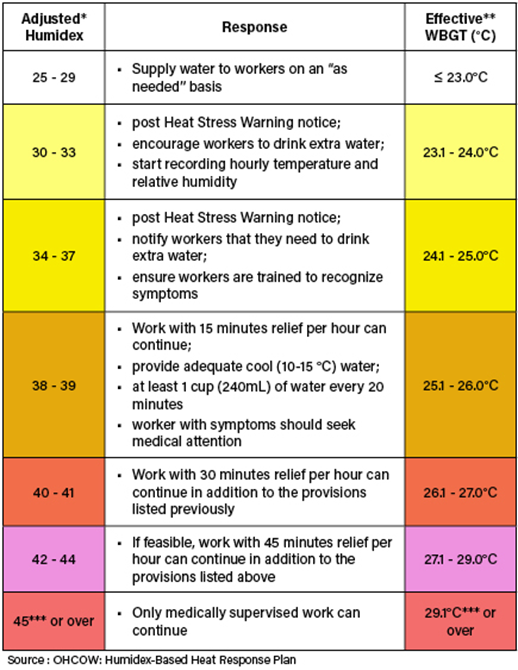
Throughout our work on this project, we also found that a warm space retains its heat and humidity well into the fall season. This further prolongs the problem, causing additional losses in productivity.
How can we overcome these challenges?
There are two options:
- A warehouse air-conditioning system
- Treats air via temperature modification and air circulation
- A summer ventilation system
- Treats via air exchange, providing a supply of fresh air
Both options improve air quality and contribute to healthy working conditions. Which one is the right fit? In some cases, an air conditioning system is the only viable option. However, this can be expensive. In this article we illustrate how a summer ventilation system can be an effective and less costly option. We’ll also help you decide which is right for your facility.
What is a Summer Ventilation System?
A summer ventilation system is a series of fans and/or louvers that flush the space with outdoor air. The system is usually sized to provide 2-4 Air Changes per Hour (ACH) of fresh air ventilation through a building. This is achieved by a combination of exhaust fans interlocked with air intake louvers or supply air fans. We space these components at opposite ends of the area (ie. exhaust fans on the north side, louvers/supply fans on the south side) in order to create laminar cross flow across the warehouse.
In most cases, we configure the system to operate during the evening when the outdoor ambient temperature has cooled from daytime highs. This flushes the warehouse space with this cooler air, and retains the benefits of a lower temperature condition into the daytime operating hours.
Since these fans are sized for high airflows (between 20,000 to 50,000 Cubic Feet per Minute or CFM), selecting the best fan for the job is crucial. We can help by recommending the correct fan for your warehouse facility needs.
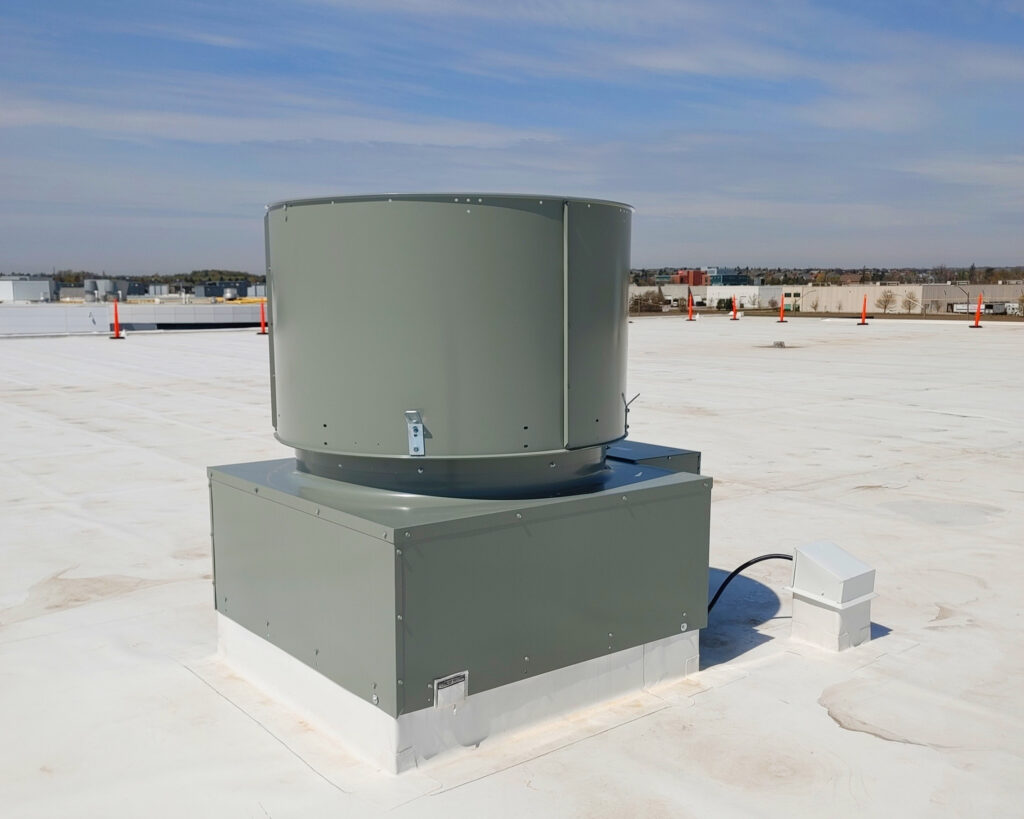
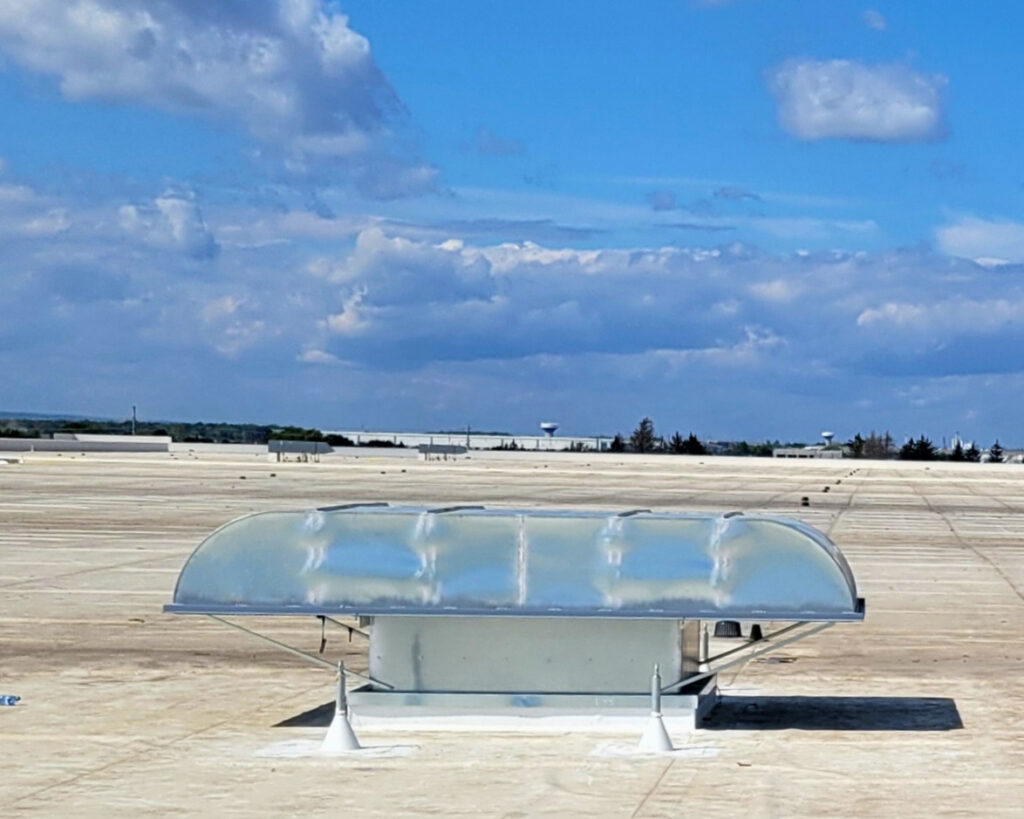
In most cases, we recommend axial upblast exhaust fans (above, left) and hooded axial supply fans (above, right).
The benefits of these fan types are:
- They can accommodate the high CFMs required.
- Installation and servicing is completed from the roof to avoid disruption to the space below.
- The upblast exhaust fans have integral butterfly dampers to prevent cold air infiltration during the winter.
- The hooded supply fans prevent rain or dust from entering the supply air stream.
- The addition of filters to these fans provides a further level protection.
Many of the systems we design use a Building Automation System (BAS) or standalone controllers to operate the summer ventilation components. The automation system works by comparing the indoor/outdoor temperatures and enthalpy levels. Once the setpoint temperatures and conditions are met, the equipment activates. The system also can also operate in “economizer” mode or be manually engaged to ventilate the space during ideal outdoor conditions.
Summer Ventilation Effectiveness
As your engineering partners and experts, we understand how important proper warehouse ventilation is to the productivity and success of your facility. Using our expertise we can guide you in making the best decisions for your building and your business.
Summer ventilation is a proven solution which we have applied to numerous large warehouse projects. This system uses significantly less energy than a conventional air conditioning system. Our clients and their teams find benefits with increased productivity and worker health and safety.
We can also increase the effectiveness of a summer ventilation system through the use of High Volume Low Speed (HVLS) fans or local circulation fans installed at dense occupant areas.
In a recently implemented Brumar design, our clients reported improved average warehouse temperatures of 24-25°C, compared to outdoor temperatures between 32-35°C.
Is a Summer Ventilation System right for your facility?
When examining these systems, it is important to weigh the advantages and drawbacks of both:
| Warehouse Air-Conditioning System | Summer Ventilation System |
| Treats air via temperature modification and circulation | Treats air via fresh air exchange |
| Stabilizes air temperature | Air temperature fluctuates with external conditions |
| Greater control over humidity | Less impact on humidity levels |
| More costly | More efficient |
The summer ventilation system is an efficient solution for many of our clients. However, because air temperatures in a ventilation system will fluctuate, it cannot be considered in warehouses that have set critical temperature and humidity parameters. In those applications, a warehouse air conditioning system is needed instead.
Still have Questions?
At Brumar we can help you design a solution that fits your needs. If you are developing a warehouse project, you may want to consider the benefits of a summer ventilation system. Let us guide you through the process.

Designs thaT
We’re here to deliver innovative, sustainable engineering solutions that help you thrive and create a reliable, resilient future.
